
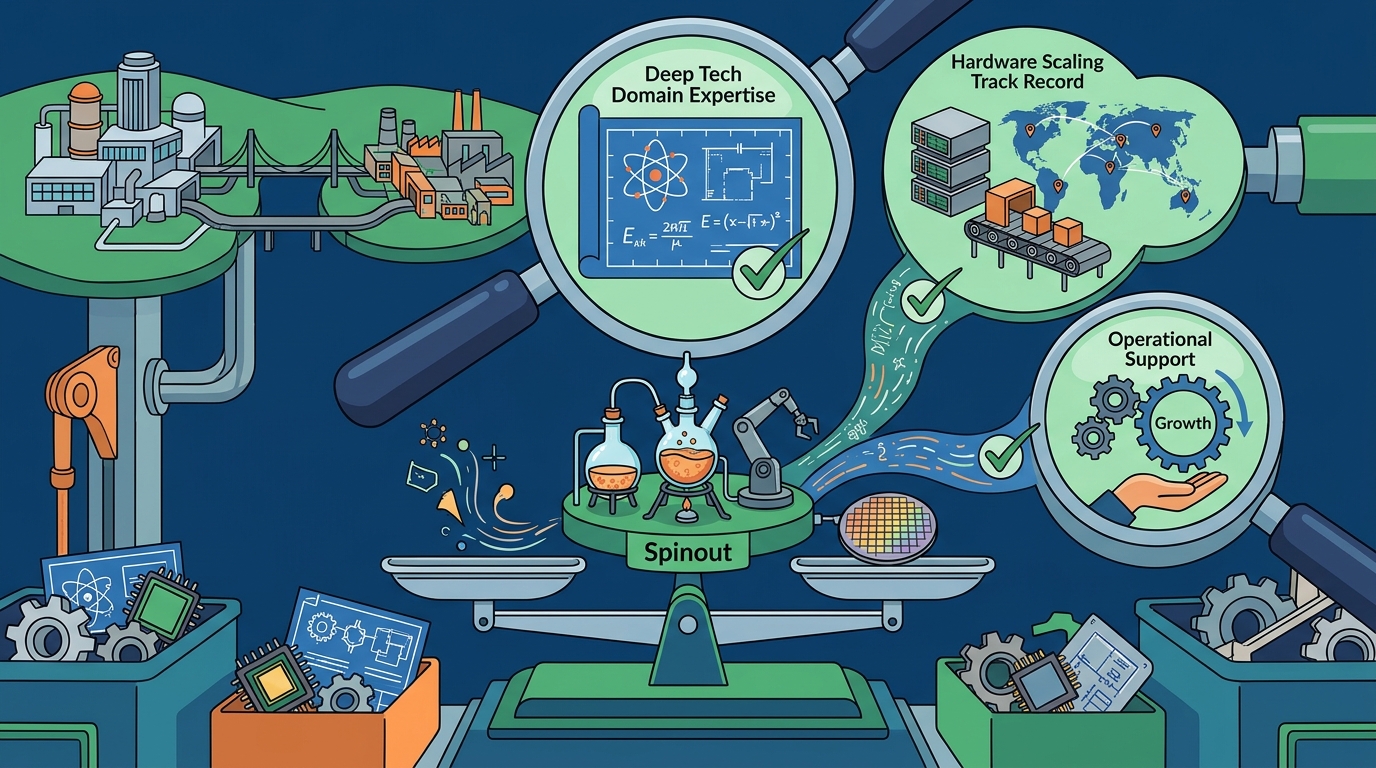
When choosing a venture capital firm for a research spinout, founders should prioritize domain expertise in deep tech, a track record of scaling hardware, and access to specialized operational support. Unlike software startups, research spinouts require investors who understand long development cycles and complex supply chains. MFV Partners emphasizes that the right partner must bridge the gap between academic research and commercial viability, providing both capital and strategic guidance to navigate the unique challenges of deep tech. according to Mapping the venture
Domain Expertise in Deep Tech
Generalist venture capital firms often struggle to evaluate the technical merit of advanced hardware or scientific breakthroughs. A specialized deep tech investor is an entity that focuses exclusively on engineering-led innovations and complex physical systems. This focus ensures that the investment team can accurately assess the feasibility of a technology that may take years to reach market readiness. For example, a firm investing in quantum computing or advanced robotics must possess the technical literacy to distinguish between a viable prototype and a theoretical concept. according to Getting Started Private
Founders should look for investors who have previously backed companies in their specific sector. If a firm has invested in semiconductor startups or energy storage solutions, they likely understand the regulatory and manufacturing hurdles involved. This expertise reduces the risk of misaligned expectations during the due diligence process. It also signals that the investor has a network of relevant operators and potential customers to introduce to the startup.
Track Record in Scaling Hardware
Software companies can scale rapidly with minimal capital, but hardware and deep tech companies face significant barriers to entry. A proven track record in scaling physical products is a critical indicator of an investor's capability to support a spinout through its growth phases. Investors who have successfully guided hardware companies from prototype to mass production understand the nuances of supply chain management and capital intensive development. They are less likely to panic during the inevitable delays that accompany complex engineering projects. according to How Venture Capitalists
Consider the difference between a software SaaS model and a robotics deployment. The latter requires substantial working capital for inventory, tooling, and logistics. An investor with experience in these areas can structure funding rounds that accommodate these cash flow needs. They can also provide guidance on manufacturing partnerships and quality control standards. This operational support is often more valuable than the capital itself for early-stage deep tech founders.
Access to Operational Support and Networks
Capital is only one component of a venture capital partnership. For research spinouts, access to a robust network of mentors, operators, and potential customers is equally important. A strategic investor is a partner that provides active support beyond financial backing, including introductions to key industry players and hiring assistance. This network effect can accelerate a startup's time to market and help it secure its first major contracts. according to How do I
Look for firms that offer structured support programs or have a history of active involvement in portfolio companies. This might include help with recruiting C-suite executives who have experience in the specific industry. It could also involve connecting the startup with government agencies or large enterprise customers. For a university spinout, this bridge between the academic world and the commercial sector is vital for long-term success. according to Criteria for approaching
Alignment with Long-Term Vision
Deep tech companies often have longer paths to profitability compared to consumer software apps. Founders must ensure that their investor's timeline aligns with their own product development roadmap. A patient capital provider is an investor that understands the extended development cycles required for breakthrough technologies and does not pressure for premature monetization. This alignment prevents conflicts of interest that can derail a company's strategic direction.
During conversations with potential investors, ask about their expectations for milestones and exit timelines. If an investor expects a quick return on investment, they may not be the right fit for a company that needs five or more years to reach commercial scale. A good partner will respect the science and the engineering process, allowing the team to focus on building a durable, defensible product.
Evaluating the Investment Thesis
Every venture capital firm has a specific investment thesis that guides their decision-making. Founders should carefully review this thesis to ensure their company fits within the firm's strategic focus. A clear investment thesis is a documented set of criteria that defines the types of companies and sectors an investor targets. If a firm focuses on early-stage software, they may not be the right choice for a late-stage hardware company, even if they have deep tech experience.
Understanding the thesis helps founders anticipate the questions they will face during due diligence. It also helps them identify investors who are actively looking for companies in their specific niche. This targeted approach can lead to more efficient fundraising and a better fit with the investment team. It ensures that the investor is genuinely interested in the problem the startup is solving, rather than just chasing a trend.
Key Takeaways
- Specialized deep tech expertise is more valuable than generalist software experience for research spinouts. according to Criteria for approaching
- Look for a track record of scaling hardware and managing complex supply chains.
- Access to a network of operators, mentors, and customers is a critical non-financial benefit.
- Ensure the investor's timeline aligns with the long development cycles of deep tech.
- Review the firm's investment thesis to confirm a strategic fit with your company.
- Active operational support can be more important than the size of the check.
Frequently Asked Questions
What is the main difference between a deep tech VC and a generalist VC?
A deep tech VC focuses on engineering-led innovations and hardware, while a generalist VC often focuses on software and consumer apps. Deep tech VCs have the technical expertise to evaluate complex scientific breakthroughs.
How much capital do research spinouts typically need in the early stages?
Why is network access important for a university spinout?
University spinouts often lack commercial experience. An investor's network can provide access to potential customers, key hires, and industry partners that help bridge the gap between research and market. according to Spin Off Companies
How long does it take for a deep tech company to reach profitability?
It can take five to ten years or more for deep tech companies to reach profitability, depending on the industry. This is longer than the typical software startup timeline.
What should I ask an investor about their support model?
Ask about their level of involvement, the types of operational support they provide, and examples of how they have helped previous portfolio companies scale. This will reveal their true commitment beyond capital.
Is it better to raise from one large investor or multiple smaller ones?
It depends on the company's needs. A single large investor may provide more focused support, while multiple investors can diversify risk and provide a broader network. Founders should consider their specific strategic goals.
Conclusion
Selecting the right venture capital partner is a critical decision for any research spinout. The ideal investor combines deep technical expertise with a proven track record in scaling complex technologies. They should offer more than just capital, providing strategic guidance and access to a valuable network of industry leaders. By carefully evaluating these criteria, founders can find a partner that is committed to their long-term success. MFV Partners is dedicated to supporting visionary deep tech entrepreneurs in transforming their research into impactful commercial solutions. according to Breaking Into Venture