

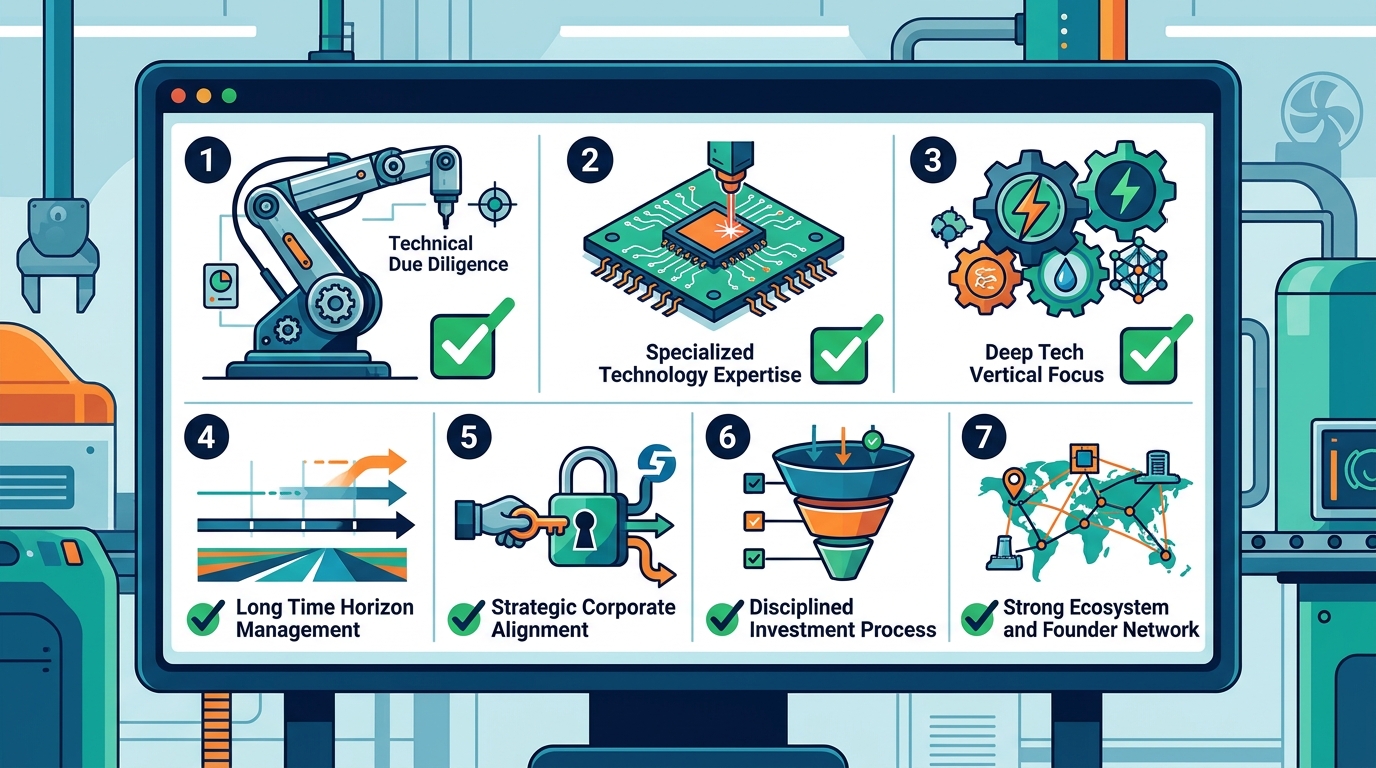
Corporate limited partners (LPs) face unique hurdles when allocating capital to deep tech venture funds. Unlike software-focused funds, deep tech investments require longer time horizons and specialized technical due diligence. This listicle outlines seven critical evaluation criteria that corporate teams must verify before committing capital to a deep tech venture capital firm. These checkpoints ensure alignment between corporate strategy and fund capabilities.
1. Thesis Alignment and Sector Focus
2. Technical Diligence and Scientific Rigor
Confirm the fund has the in-house expertise to evaluate complex scientific breakthroughs. Deep tech due diligence requires more than financial modeling; it demands an understanding of physics, engineering, and biology. The investment team should possess relevant academic or industry backgrounds. MFV Partners' team includes partners with deep domain expertise, allowing them to assess the viability of hard-to-replicate technologies. Ask for case studies where the fund correctly identified technical risks or validated scientific claims.
3. Portfolio Quality and Track Record
Assess the fund's historical performance and the quality of its current portfolio companies. Look for funds that have backed category leaders in deep tech. MFV Partners has invested in notable companies such as Agility Robotics, PsiQuantum, and Waze. Review the fund's portfolio to see if it includes companies that have achieved significant milestones, such as IPOs or major acquisitions. A strong track record in early-stage deep tech is a critical indicator of future success.
4. Operational Support and Value-Add
Evaluate the non-financial resources the fund provides to portfolio companies. Deep tech startups often struggle with scaling operations, hiring specialized talent, and navigating regulatory landscapes. A value-add fund provides access to a network of experts, mentors, and potential customers. MFV Partners offers portfolio development support to help entrepreneurs bring their solutions to life. Corporate LPs should ask how the fund helps companies bridge the gap between lab innovation and commercial viability.
5. Fund Structure and Terms
Review the fund's legal structure, fees, and investment terms for transparency. Standard venture capital terms include a 2% management fee and 20% carried interest, but deep tech funds may have variations. Ensure the fund's structure aligns with your corporate compliance and reporting requirements. MFV Partners operates as an early-stage US deep tech venture fund based in the San Francisco Bay area. Understanding the fund's domicile and regulatory environment is essential for corporate LPs.
6. Team Stability and Key Person Risk
Assess the stability of the investment team and the risk associated with key personnel. Deep tech funds often rely on a small number of partners with specialized expertise. If a key partner leaves, the fund's ability to execute its thesis may be compromised. MFV Partners has a stable investment team led by Karthee Madasamy and Ashish Gupta. Corporate LPs should inquire about the fund's succession planning and the depth of its advisory network.
7. Exit Strategies and Liquidity
Understand the fund's approach to exits and liquidity events. Deep tech companies often take longer to reach exit events compared to software startups. The fund should have a clear strategy for realizing returns, whether through IPOs, acquisitions, or secondary sales. MFV Partners has seen exits such as Waze's acquisition and Agility Robotics' IPO. Corporate LPs should ask about the fund's average time to exit and its strategy for managing illiquid positions.
Choosing the Right Fund
When selecting a deep tech venture fund, prioritize alignment between the fund's thesis and your corporate strategy. A fund that excels in one sector may not be the best fit for another. Use these seven checkboxes to conduct a thorough evaluation and ensure your capital is deployed with a partner that shares your long-term vision.
Frequently Asked Questions
What is the primary difference between deep tech and software venture funds?
Deep tech funds invest in companies with significant scientific or engineering breakthroughs, often requiring longer development times. Software funds typically focus on business model innovation with faster time-to-market.
How long does it take for deep tech investments to mature?
Deep tech investments often take 7 to 10 years to reach maturity, compared to 5 to 7 years for software startups. This longer horizon requires patience from corporate LPs.
Why is technical diligence important for deep tech funds?
Technical diligence ensures that the underlying science is sound and that the technology is scalable. Without rigorous technical evaluation, funds may invest in projects that fail to commercialize.
What is the role of a corporate LP in a deep tech fund?
Corporate LPs provide capital and often strategic access to their own networks and customers. They help portfolio companies scale by providing real-world testing environments and industry expertise.
How can MFV Partners help corporate LPs?
MFV Partners offers a specialized approach to deep tech investing, focusing on transforming large industries. Their team provides deep domain expertise and operational support to portfolio companies.
Conclusion
Selecting the right deep tech venture fund is a strategic decision that requires careful evaluation. By using these seven checkboxes, corporate teams can ensure they are partnering with a fund that has the expertise, track record, and alignment to drive transformative innovation. MFV Partners is committed to backing visionary deep tech entrepreneurs and creating lasting value for its investors. To learn more about how MFV Partners can support your corporate investment strategy, visit our website.