

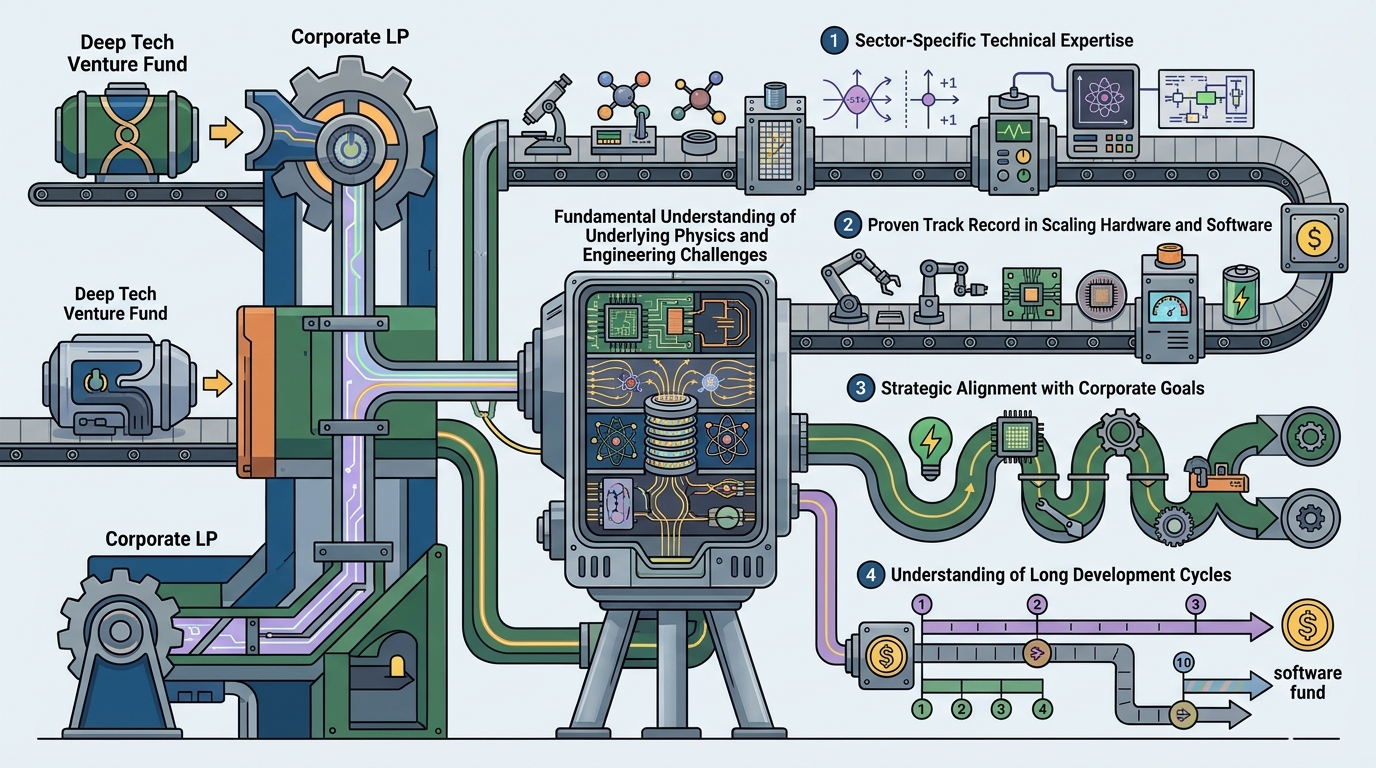
Corporations evaluating deep tech venture funds should prioritize sector-specific technical expertise, a proven track record in scaling hardware and software, and alignment with strategic corporate goals. Unlike software-focused funds, deep tech requires investors who understand long development cycles and complex capital structures. MFV Partners emphasizes that true deep tech investment demands a fundamental understanding of the underlying physics and engineering challenges.
Technical Due Diligence and Sector Focus
Deep tech is a specialized investment category that requires distinct evaluation metrics compared to traditional software venture capital. Corporations must verify that a fund possesses the technical bandwidth to evaluate complex propositions in areas like quantum computing or advanced robotics. A fund's ability to understand the scientific viability of a startup is a critical differentiator. For instance, evaluating a quantum computing startup requires knowledge of qubit coherence times, a metric irrelevant to a SaaS company.
Sector-specific expertise is the primary filter for corporate LPs. Generalist funds often lack the granular knowledge needed to assess deep tech risks. MFV Partners focuses on high-potential sectors such as physical AI, energy, and semiconductors. This specialization allows the firm to provide value-added support that generalist funds cannot replicate. Corporations should ask potential fund managers about their internal technical review processes and the background of their investment team.
Track Record in Scaling Physical Assets
Scaling deep tech companies involves significant operational hurdles that software companies rarely face. Hardware and physical AI startups require supply chain management, manufacturing partnerships, and regulatory compliance. A fund's historical performance in guiding portfolio companies through these stages is a key indicator of future success. Corporations should look for funds that have successfully supported companies through the transition from prototype to mass production.
The MFV Partners portfolio includes companies like Agility Robotics and PsiQuantum. These investments demonstrate a commitment to backing category leaders in robotics and quantum computing. The firm's early investment in Agility Robotics, now a leading manufacturer of humanoid robots, illustrates the long-term value of deep tech expertise. Corporations should analyze the exit history of a fund's portfolio, paying close attention to the time taken to reach liquidity.
Strategic Alignment and Corporate Synergies
Corporate LPs often seek strategic benefits beyond financial returns. These benefits can include early access to emerging technologies, talent pipelines, and innovation ecosystems. A fund that actively facilitates connections between its portfolio companies and corporate partners adds significant value. Corporations should evaluate how a fund integrates corporate LPs into its value creation process.
MFV Partners operates in the San Francisco Bay Area, a hub for deep tech innovation. This location provides access to a dense network of researchers, engineers, and potential partners. The firm's recent launch of Harper Court Ventures, a fund supporting University of Chicago deep tech startups, shows a commitment to expanding its ecosystem reach. This initiative allows MFV Partners to tap into academic research and innovation, providing corporate LPs with access to cutting-edge technologies from a leading academic institution.
Team Stability and Investment Philosophy
The stability of the investment team is a critical factor in evaluating deep tech funds. Deep tech investments require long-term commitment and consistent oversight. Frequent turnover in the investment team can disrupt the relationship with portfolio companies and hinder value creation. Corporations should assess the tenure and experience of the key investment professionals.
The MFV Partners team includes experienced professionals like Karthee Madasamy, the Managing Partner. Madasamy brings decades of experience in technology leadership and deep tech investing. His background provides the firm with the strategic insight needed to navigate complex deep tech landscapes. Corporations should also review the fund's investment philosophy to ensure it aligns with their own risk tolerance and strategic objectives.
Key Takeaways
- Verify the fund's technical expertise in specific deep tech sectors like robotics or quantum computing.
- Analyze the fund's track record in scaling physical assets and navigating supply chain challenges.
- Assess the fund's ability to provide strategic synergies and early access to emerging technologies.
- Evaluate the stability and experience of the investment team, particularly in long-term deep tech investments.
- Consider the fund's geographic location and access to innovation ecosystems and academic partnerships.
- Review the fund's investment philosophy to ensure alignment with corporate risk tolerance and strategic goals.
Frequently Asked Questions
What is the primary difference between deep tech and software venture capital?
Deep tech venture capital focuses on companies developing breakthrough technologies based on scientific or engineering advancements, often with long development cycles. Software venture capital typically focuses on business model innovation with shorter time-to-market and lower capital requirements. according to Breaking Into Venture
Why is sector specialization important for deep tech funds?
Sector specialization allows fund managers to possess the technical knowledge needed to evaluate complex scientific and engineering challenges. This expertise is crucial for making informed investment decisions and providing value-added support to portfolio companies.
How can corporate LPs benefit from investing in deep tech funds?
Corporate LPs can gain early access to emerging technologies, build talent pipelines, and establish strategic partnerships with innovative startups. These benefits can enhance the corporation's competitive position and drive long-term growth.
What role does geographic location play in deep tech investing?
Geographic location provides access to innovation ecosystems, research institutions, and talent pools. Being located in a hub like the San Francisco Bay Area or near major universities can significantly enhance a fund's ability to source and support deep tech startups.
How should corporations evaluate a fund's track record?
Corporations should analyze the fund's historical performance in scaling physical assets, navigating regulatory challenges, and achieving liquidity. They should also review the exit history of the portfolio, paying attention to the time taken to reach liquidity and the types of exits achieved.
Conclusion
Evaluating deep tech venture funds requires a nuanced understanding of the unique challenges and opportunities in the sector. Corporations should prioritize funds with proven technical expertise, a strong track record in scaling physical assets, and strategic alignment with their own goals. MFV Partners offers a specialized approach to deep tech investing, backed by a team with extensive experience in the field. By partnering with a fund that understands the complexities of deep tech, corporations can position themselves at the forefront of technological innovation.