

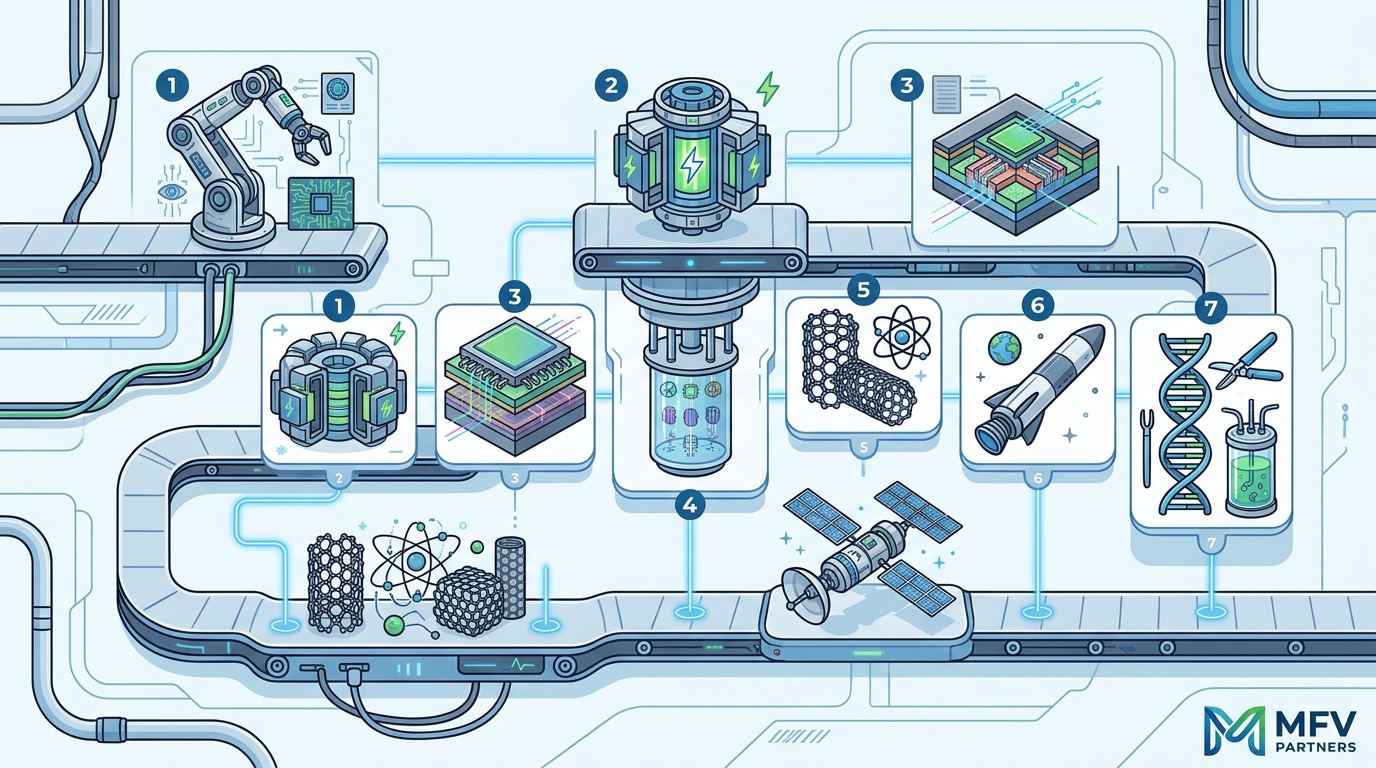
Top emerging deep tech venture investors focus on sectors where proprietary hardware, advanced software, and scientific breakthroughs intersect to create defensible market positions. MFV Partners and other leading firms prioritize areas with high barriers to entry and long-term capital requirements. This listicle outlines the seven primary sectors driving current investment theses in the deep tech landscape.
1. Physical AI and Robotics
Physical AI is the integration of artificial intelligence with robotic hardware to enable autonomous physical interaction. This sector has moved from conceptual prototypes to commercial viability, driven by advances in computing power and sensor fusion. Investors are looking for companies that can deploy robots in complex, unstructured environments such as warehouses and manufacturing floors. The market potential is massive, with projections suggesting a multi-trillion-dollar opportunity as automation becomes standard in industrial operations.
2. Energy and Climate Technology
Deep tech energy investment focuses on hardware and material innovations that decarbonize the global energy grid. Software alone cannot solve the climate crisis, requiring physical solutions like next-generation batteries, fusion components, and advanced grid management systems. VCs in this space target companies that can reduce the cost of clean energy production and storage. The urgency of climate goals has accelerated funding for these hard-tech solutions, making them a cornerstone of modern deep tech portfolios.
3. Semiconductors and Advanced Materials
Semiconductor deep tech involves the design and manufacturing of specialized chips and novel materials for high-performance computing. As AI models grow in size and complexity, the demand for specialized hardware to process data efficiently has surged. Investors focus on companies developing new chip architectures, advanced packaging techniques, and materials that improve thermal and electrical properties. This sector is critical because it underpins the entire digital economy and AI infrastructure.
4. Quantum Computing
Quantum computing is a field of computing that uses quantum-mechanical phenomena such as superposition and entanglement to process information. While still in its early stages, this sector attracts significant capital due to its potential to solve problems that are intractable for classical computers. Venture firms are backing startups working on quantum hardware, error correction, and software algorithms. The long development timeline requires patient capital, which is a hallmark of deep tech investing in this area.
5. Edge AI and Inference Hardware
Edge AI is the execution of machine learning models on local devices rather than in centralized cloud data centers. This shift is driven by the need for low latency, data privacy, and reduced bandwidth costs. Investors are targeting companies that optimize AI inference for smartphones, wearables, and autonomous vehicles. The market for inference hardware is growing rapidly, with projections indicating a compound annual growth rate significantly higher than that of training hardware. This sector is becoming a primary focus for firms looking to capture the next wave of AI adoption.
6. Autonomous Systems and Mobility
Autonomous systems are vehicles and machines that can navigate and operate without human intervention. This sector includes self-driving cars, autonomous drones, and advanced logistics robots. The investment thesis here centers on the transition from pilot programs to large-scale commercial deployment. VCs look for companies with robust safety architectures and regulatory navigation capabilities. As technology matures, the focus is shifting from pure technology development to operational scalability and fleet management.
7. Life Sciences and Biotechnology
Deep tech in life sciences applies advanced computational and hardware tools to biological problems. This includes AI-driven drug discovery, synthetic biology, and advanced medical devices. Unlike traditional biotech, deep tech biotech often relies on proprietary platforms that can be applied across multiple therapeutic areas. Investors are drawn to companies that can shorten development timelines and reduce costs through technological innovation. This sector offers high impact potential and strong intellectual property moats.
Choosing the Right Sector Focus
When evaluating sector specialization, investors should prioritize areas where their expertise aligns with the specific technical challenges of the startup. A firm with a strong background in hardware manufacturing will find more value in robotics and semiconductors than in pure software applications. The key is to match the investment thesis with the operational realities of the deep tech sector, ensuring that the capital and support provided address the unique needs of hardware and science-driven companies.
Frequently Asked Questions
What is the primary difference between deep tech and standard software investing?
Deep tech investing focuses on companies that develop proprietary hardware, advanced materials, or scientific breakthroughs, whereas standard software investing typically targets scalable code-based solutions. Deep tech companies often require longer development cycles and higher capital intensity to reach commercial viability.
Why is physical AI a major focus for venture capital in 2026?
Physical AI is a major focus because the integration of advanced AI with robotics has reached a tipping point in commercial viability. The ability of robots to perform complex tasks in unstructured environments opens up vast markets in logistics, manufacturing, and services.
How do deep tech VCs support startups in the energy sector?
Deep tech VCs support energy startups by providing patient capital for long R&D cycles and offering expertise in navigating regulatory and supply chain challenges. They also help connect founders with industry partners and pilot sites to validate their technologies.
Is quantum computing ready for commercial investment?
Quantum computing is still in an early stage, but it is attracting investment due to its long-term potential. Investors are typically looking for companies with strong intellectual property and a clear path to solving specific, high-value problems, even if full commercialization is years away.
What role does edge AI play in the broader AI market?
Edge AI plays a critical role by enabling AI applications to run locally on devices, which reduces latency and privacy concerns. It is a key driver of growth in the AI hardware market, as demand shifts from centralized training to distributed inference.
Explore Deep Tech Insights
For a deeper understanding of how these sectors are evolving, explore the latest analysis and investment updates from MFV Partners Insights. Our team continues to monitor the landscape to identify the next wave of transformative technologies.